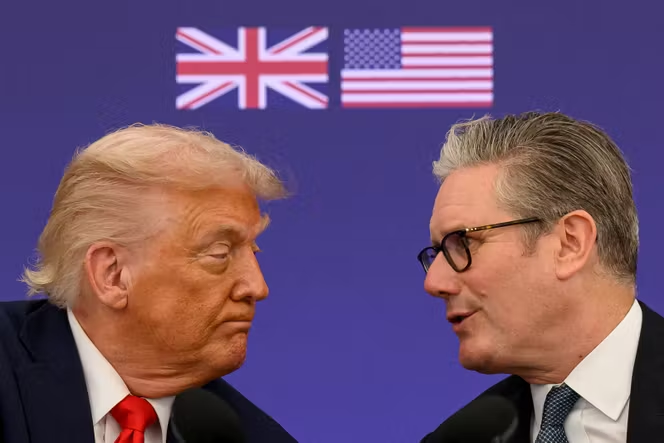
The remarks follow a dispute over Britain’s role in US military operations targeting Iran’s missile launchers and weapons facilities. On Sunday, the Prime Minister authorised the United States to use certain UK bases for defensive operations aimed at protecting allied nations from attacks by Tehran.
However, President Trump expressed frustration at what he described as an initial refusal to allow the use of the UK–US base at Diego Garcia, located in the Chagos Islands. He said it had taken “far too long” for approval to be granted.
“He has not been helpful. I never thought I’d see that from the UK. We love the UK,” Mr Trump said, adding that Britain’s response had differed from other allies. “France has been great. They’ve all been great. The UK has been much different.”
Speaking about the broader alliance, he described the current climate as “a much different kind of relationship” and said it was “very sad” to witness the apparent shift.
The disagreement marks the most serious public rift so far between the two leaders, amid wider tensions over Britain’s Chagos Islands agreement, US global tariff measures and President Trump’s foreign policy approach, including controversial remarks about Greenland.
Addressing MPs in the House of Commons, Sir Keir stood by his decision, insisting that Britain would act only where there was a clear legal basis and where national interests were directly engaged.
“President Trump has expressed his disagreement with our decision not to get involved in the initial strikes,” he said. “But it is my duty to judge what is in Britain’s national interest. That is what I have done, and I stand by it.”
He also referenced the legacy of the 2003 Iraq war under Tony Blair, stating that lessons had been learned about the importance of lawful justification for military action.
Cabinet minister Darren Jones echoed that position, stressing that decisions were taken “on the basis of legality and British interest”. He confirmed that the UK had agreed to the use of Diego Garcia and RAF Fairford for operations intended to reduce risks to British citizens and assets in the region, but made clear that Britain was not involved in the initial wave of strikes.
“We are not going to war with Iran,” he said, underlining that the Government would not participate in offensive operations.
The diplomatic tension comes as conflict in the Middle East intensifies. President Trump has warned that the “biggest wave” of attacks on Iran is yet to come. Meanwhile, an Iranian drone was intercepted near the RAF Akrotiri base in Cyprus. Downing Street stated the drone launch predated the UK’s announcement and was not a direct response to it.
Around 300,000 British nationals are believed to be in countries affected by the escalation, with more than 100,000 registered with the Foreign Office. Contingency planning, including potential evacuation measures, is under way.
In Parliament, Labour MPs broadly backed the Prime Minister’s emphasis on international law. However, opposition Conservatives and Reform UK figures questioned whether the Government had shown sufficient solidarity with Washington during a period of heightened global instability.
The episode leaves the US–UK partnership facing renewed scrutiny, with both leaders now navigating a delicate balance between strategic cooperation and domestic political pressures.