
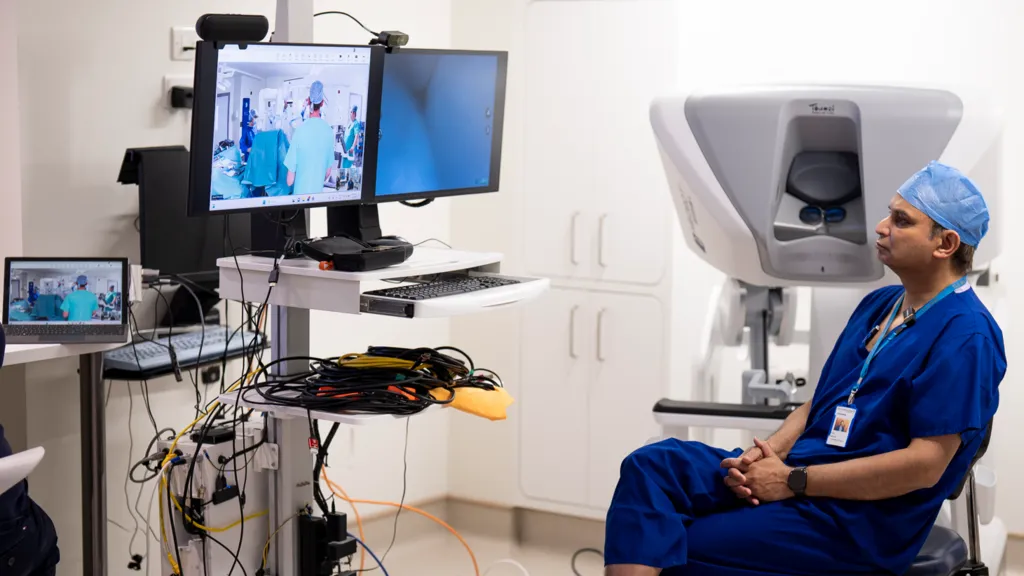
Prokar Dasgupta, a leading robotic urological surgeon, performed a prostate removal procedure from The London Clinic while the patient remained in Gibraltar.
The patient, 62 year old Paul Buxton, described taking part in the trial as an easy decision and said he felt proud to contribute to what he called medical history.
Buxton, originally from Burnham-on-Sea in Somerset, moved to Gibraltar about 40 years ago. After receiving a prostate cancer diagnosis shortly after Christmas, he expected to join an NHS waiting list in the UK. Instead, he agreed to undergo the pioneering remote procedure.
Gibraltar, a British overseas territory, has only one hospital, St Bernard’s Hospital. Residents with complex medical conditions often need to travel abroad for specialist treatment, usually to the UK.
Buxton said that without the remote option, he would likely have needed to travel to London, remain on a waiting list and spend several weeks away from home. He described the telesurgery trial as a straightforward choice and said he felt well supported throughout the process.
The operation was conducted using the Toumai Robotic System. The system features a high definition 3D camera and four robotic arms controlled remotely by the surgeon through a console.
The console in London was connected to the robotic equipment in Gibraltar via fibre optic cables, supported by a backup 5G connection. The system operated with a delay of just 0.06 seconds. A medical team in Gibraltar remained on standby throughout the procedure in case technical support was required, although the connection remained stable.
The project was developed in collaboration between The London Clinic and the Gibraltar Health Authority.
Professor Dasgupta said the breakthrough could help extend specialist surgical care to smaller communities and remote regions by allowing expert surgeons to operate from long distances.
This was the first of two test cases in Gibraltar. A second patient, aged 52, underwent a similar procedure earlier this month.
Another operation is scheduled to be performed later in March and will be live streamed to thousands of urological specialists attending the annual congress of the European Association of Urology.
Healthcare experts say the development forms part of wider efforts to expand robotic assisted surgery. The UK health service has set ambitions to significantly increase the number of robot supported operations in the coming years, aiming for hundreds of thousands annually by 2035.
Researchers believe remote surgery could reduce the need for patients to travel long distances for specialist care, potentially lowering costs and improving access to treatment in underserved areas.