
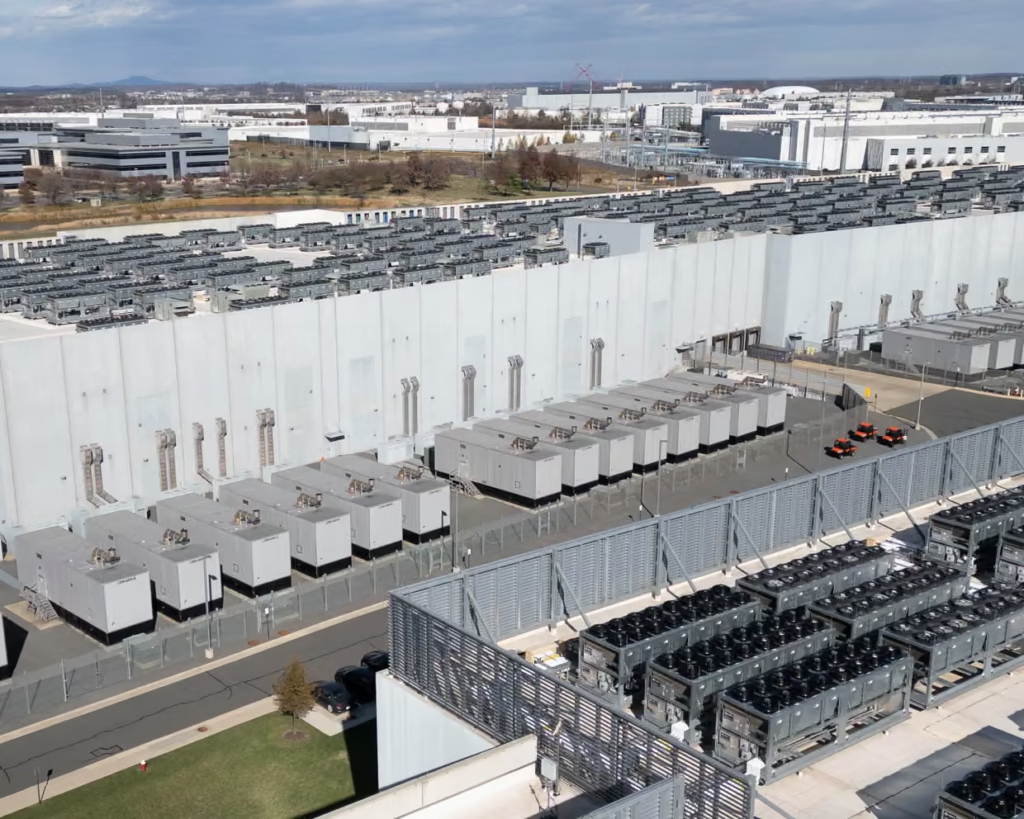
Northumberland county council has approved the first phase of a hyperscale datacentre campus at Cambois, being developed by the US firm QTS. The company has promoted its use of a closed-loop cooling system as evidence that the site will be effectively “water-free”.
However, research published this week questions that claim. A study by data scientist Alex de Vries-Gao, examining the power and water footprints of artificial intelligence production, highlights the scale of indirect or “embedded” water consumption linked to datacentre energy use.
QTS told the council that its first two data halls would use about 2.3 million litres of water a year. But applying De Vries-Gao’s methodology to the electricity required to run AI servers suggests indirect water use could reach around 124 million litres annually more than 50 times higher according to analysis by Watershed Investigations and the Guardian.
When all ten planned data halls are operational, indirect water consumption at the Cambois site could rise to about 621 million litres a year, equivalent to the average annual water use of more than 11,000 people.
Although QTS uses a closed-loop cooling system that recirculates water, the approach increases energy demand to cool servers. The company has said its direct operations will not place pressure on water supplies in the north-east.
In a statement, QTS said: “Our power is typically carbon neutral and comes from a range of sources including wind, hydro, nuclear and tidal. QTS does not control the quantity of any water utilised in the power generation process.”
De Vries-Gao argues that datacentre operators should be accountable for water consumption driven by their electricity demand, just as energy-intensive industries are required to account for indirect carbon emissions. “The datacentre operator creates the power demand that leads to this water consumption,” he said, noting that greenhouse gas reporting rules already require disclosure of indirect emissions from electricity use.
Concerns have also been raised about potential air pollution linked to the site. Increased electricity generation and the use of diesel backup generators could contribute to higher emissions of nitrogen oxides and fine particulate matter, pollutants associated with serious health risks.
Research in the United States has already linked the rapid expansion of datacentres to deteriorating air quality. Shaolei Ren of the University of California, a co-author of a recent study, said the connection between datacentre growth and harmful health outcomes was “very strong”, adding that a lack of transparent data made it difficult to quantify the impact at local and regional levels.
Once complete, the Cambois campus will rely on nearly 600 diesel generators up to 58 per data hall to ensure uninterrupted power. QTS estimates each generator would be tested for about five hours a year. However, environmental groups warn that once installed, generators are often used more frequently than initially planned, particularly during periods of grid stress.
The potential health implications have raised local concerns. Emissions from the generators are expected to affect nearby residential areas, including the playground of Cambois primary school.
QTS said the generators would be used primarily for emergency backup and routine testing, adding that emissions would remain within permitted limits. “Diesel generators are not the main source of power for our datacentres,” the company said, noting that backup generators would only operate at reduced power during a grid outage.
Campaigners argue that without clearer accounting of water use and air pollution, communities hosting major datacentres may face underestimated environmental and public health risks.