
Data from the Society of Motor Manufacturers and Traders (SMMT) revealed that just under 40,000 new BEVs were registered in November 2025, a modest 3.6% increase from 38,600 in the same month last year. This represents the smallest year-on-year growth since December 2023, when supply chain disruptions affected sales. BEVs accounted for 26.4% of new car registrations in the year, slightly below the government’s target of 28%.
The SMMT warned that the proposed mileage-based tax could threaten the UK’s net-zero transition, potentially reducing EV sales by 440,000 over the next five years, according to estimates from the Office for Budget Responsibility.
Mike Hawes, SMMT Chief Executive, said:
“The weakest growth for almost two years, ahead of the government announcing a new tax on EVs is a wake-up call. Sustained demand for EVs cannot be taken for granted. We should be encouraging drivers to make the switch, not penalising them.”
The slowdown comes amid an overall decline in the UK car market, with total new vehicle registrations falling 1.6% to 151,154 units in November. Plug-in hybrid vehicles bucked the trend, increasing 14.8% month-on-month and representing 11.9% of registrations. Meanwhile, diesel sales dropped 24%, and petrol fell 5%.
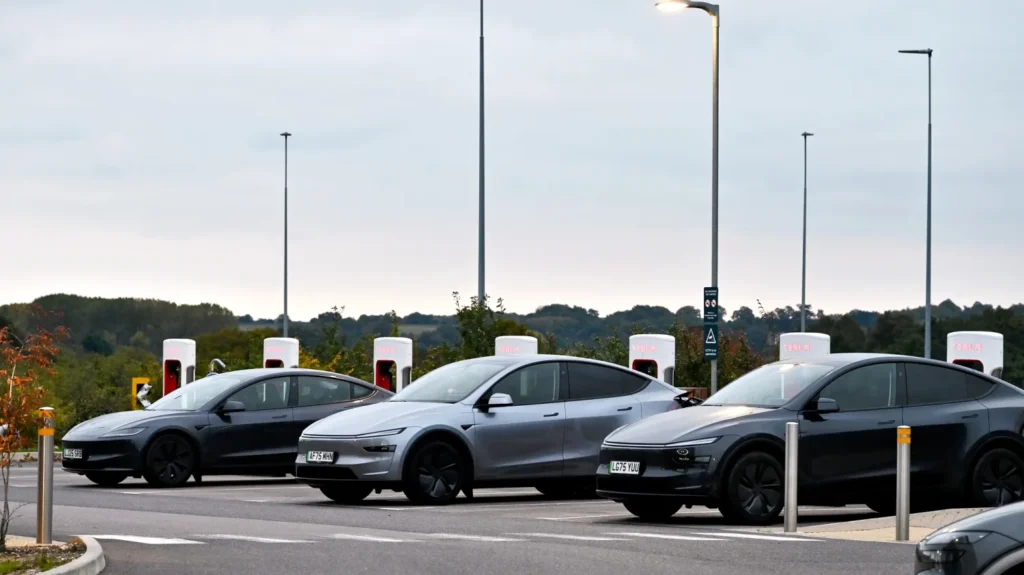
Tesla was particularly affected, with UK sales falling nearly 20% month-on-month to 3,800 vehicles, representing a 2.5% market share. In contrast, Chinese competitor BYD saw its sales triple in November, driven by strong demand for hybrids and plug-in models.
Alongside the proposed tax, the government extended grants for new EV purchases until 2030, offering maximum discounts of £3,750 on select Renault and Mini models.
Jamie Hamilton, from Deloitte, noted:
“The pay-per-mile charge may increase running costs, but changes to the expensive car supplement threshold could benefit some drivers over their lease period. However, the perception of higher costs could slow the pace of EV adoption towards the 2035 zero-emission vehicle target.”