
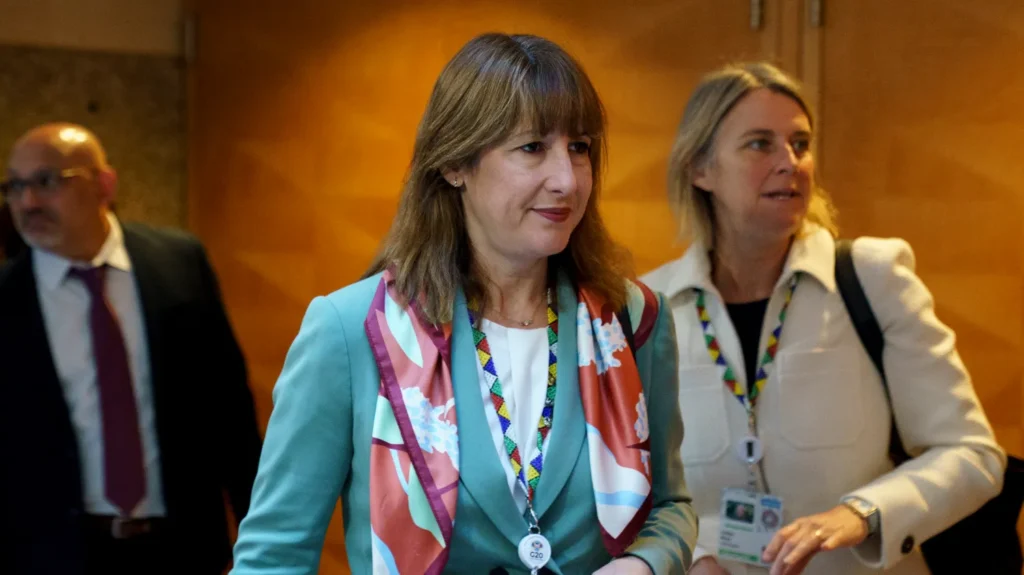
In what marks a significant change of tone, Reeves is expected to argue that the economic damage caused by the Conservatives’ Brexit deal has been far greater than previously recognised a central factor, she will claim, in the UK’s sluggish productivity and fiscal shortfall.
According to Treasury sources, the Office for Budget Responsibility (OBR) is preparing to issue a major downgrade of Britain’s productivity forecast, leaving Reeves with a funding gap of up to £18 billion per year.
This will force the chancellor to consider further tax rises, with income tax, VAT and national insurance all under review.
“The UK’s productivity challenge has been compounded by the way in which the UK left the European Union,” Reeves told an international economic committee in Washington last week.
Reeves is seeking to draw a distinction between Brexit itself and the manner in which it was implemented under Boris Johnson’s deal, positioning the Conservatives and Reform UK leader Nigel Farage as those who “pushed for Brexit then walked away”.
Her shift in messaging follows widespread criticism after the last budget, when she blamed the Tories for a dire economic inheritance. Despite the argument, Reeves remains one of the most unpopular politicians in Britain, with a net favourability rating of -49, only narrowly ahead of Prime Minister Sir Keir Starmer, on -51.
While some ministers support the chancellor’s new approach, others have warned that blaming Brexit risks reigniting deep divisions and handing political ammunition to Farage and the Conservatives.
“It’s a gift for Farage,” a senior government source told The Times. “Voters just won’t buy it.”
Yet polling suggests that public sentiment may now favour Reeves’ line. A recent YouGov survey found that 61 per cent of voters believe Brexit has been more of a failure than a success, with most blaming the Tories and Johnson’s government.
Anthony Wells, YouGov’s head of European political research, noted:
“Blaming Brexit may sound less self-serving than simply blaming the Conservatives. Public opinion has clearly shifted.”
Bank of England Governor Andrew Bailey has also hinted that the UK’s poor growth is still being shaped by Brexit, while the OBR’s forthcoming report is expected to explicitly reference Brexit’s drag on productivity.
Health Secretary Wes Streeting recently echoed that sentiment, saying:
“It’s part of it. I’m glad that Brexit is a problem whose name we now dare speak.”
As Reeves finalises her 26 November budget, her challenge remains steep to convince a sceptical public that the pain of higher taxes is the unavoidable cost of decisions made long before her tenure.